AI has moved far beyond simply answering questions.
Today, AI can write code, analyze information, recommend decisions, automate tasks, and even take actions on behalf of users.
That sounds exciting, but it also raises an important question:
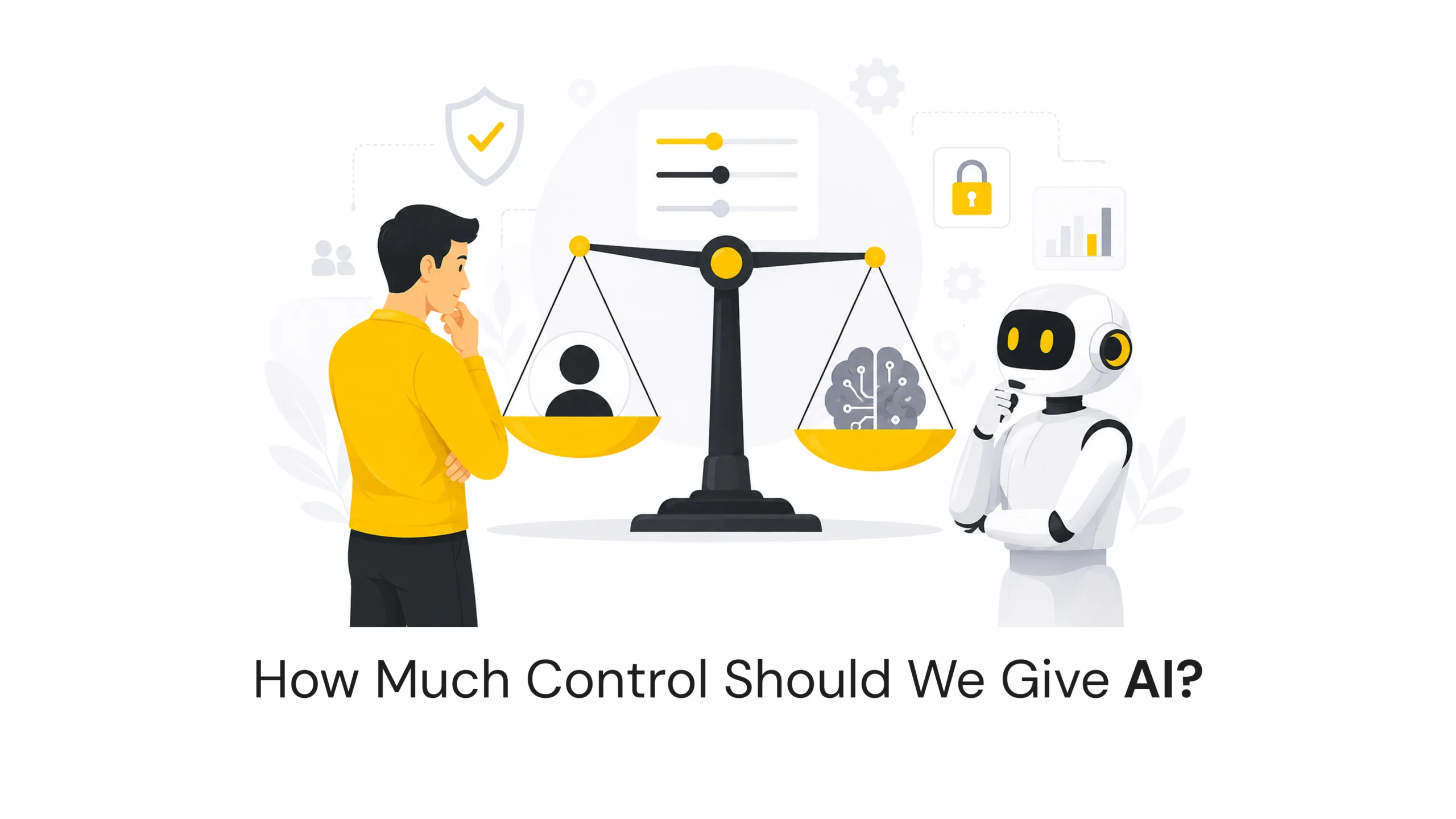
How Much Control Should We Give AI?
- August 25, 2026
- Pavithra R
- 10:00 am
Views: 284
Introduction
AI has moved far beyond simply answering questions.
Today, AI can write code, analyze information, recommend decisions, automate tasks, and even take actions on behalf of users.
That sounds exciting, but it also raises an important question:
How much control should we actually give AI?
Should AI simply make recommendations? Should it complete tasks after getting approval? Or should it be allowed to make decisions and act completely on its own?
The answer is not the same for every situation.
The real goal is not to give AI maximum control. It is to give AI the right level of control for the task.
What Does AI Control Actually Mean?
AI control refers to how much freedom an AI system has to make decisions and take actions without direct human involvement.
For example:
AI suggests:
AI recommends a product → User chooses it.
AI assists:
AI prepares an email → User reviews and sends it.
AI acts:
AI identifies a routine task → AI completes it automatically.
All three use AI, but the level of autonomy is different.
This is why AI autonomy should be treated as a spectrum rather than an all-or-nothing decision.
Why Are Businesses Giving AI More Control?
The biggest reason is simple: efficiency.
AI can handle repetitive work, process large amounts of information, and complete tasks much faster than humans.
Businesses are already exploring AI for:
- Customer support
- Data analysis
- Workflow automation
- Content creation
- Software development
- Task management
- Business recommendations
But as AI gets more control, the consequences of its mistakes can also increase.
A small mistake in a recommendation may not matter much.
A mistake that automatically changes customer data or approves a financial transaction is very different.
That’s where the level of AI control becomes important.
Finding the Right Level of AI Autonomy
AI does not need to have the same level of control for every task.
AI as an Assistant
AI provides recommendations, ideas, or information while the human makes the final decision.
This works well for tasks where human judgment is important.
AI With Approval
AI prepares an action, but the user approves it before it happens.
For example:
AI creates an email → User reviews → User sends
This gives users efficiency without completely removing control.
AI With Limited Autonomy
AI can perform certain tasks automatically within clearly defined boundaries.
For example, an AI customer-support system can handle common questions but transfer unusual or sensitive cases to a human.
Fully Autonomous AI
AI makes decisions and takes actions without direct human approval.
This can be useful for repetitive, low-risk tasks, but it requires stronger safeguards and monitoring.
The simple rule is:
The more control AI receives, the stronger the boundaries should be.
When Should Humans Stay in Control?
Human involvement becomes especially important when AI decisions involve:
- Money
- Personal information
- Employment
- Healthcare
- Legal matters
- Security
- Important business decisions
It is also important when an action is difficult to reverse.
For example, automatically organizing files is very different from automatically deleting important business data.
In these situations, AI can assist with analysis while humans remain responsible for the final decision.
What Happens When AI Makes a Mistake?
AI can make mistakes.
It may misunderstand instructions, use incomplete information, or produce an incorrect recommendation.
The more autonomous the system is, the greater the potential impact of that mistake.
So instead of only asking:
“What happens when the AI works correctly?”
Designers and developers should also ask:
“What happens when the AI gets it wrong?”
Good AI systems should have safeguards such as:
- Approval steps for high-risk actions
- Limited permissions
- Clear boundaries
- Monitoring
- Undo or recovery options
- Human intervention
Designing for failure is just as important as designing for success.
Why UX Matters in AI Control
As AI becomes more autonomous, the user experience becomes more important.
Users should always understand:
- What the AI can do
- What the AI is doing
- Why it is doing it
- When approval is required
- How to stop an action
- How to correct a mistake
Imagine an AI system changing important information without explaining what happened.
Even if the technology works correctly, the experience can feel uncomfortable.
Now imagine the same system clearly showing:
What will change → Why it will change → User approval → Action completed
That creates a much stronger sense of control and trust.
This is where thoughtful UX design becomes essential.
Designing AI That Users Can Trust
Trust does not come from giving AI more intelligence.
It comes from making AI predictable, understandable, and controllable.
Good AI experiences should include:
- Clear feedback
- Simple explanations
- Permission boundaries
- Confirmation for important actions
- Easy correction
- Undo options
- Visible system status
Users should never feel like the AI is secretly making decisions in the background.
The user should always know where the control lies.
The Future of Human-AI Collaboration
The future of AI is unlikely to be about humans completely handing over control to machines.
Instead, it will be about finding the right balance.
AI is excellent at processing information, identifying patterns, and handling repetitive work.
Humans bring judgment, context, empathy, creativity, and responsibility.
The strongest AI experiences will combine both.
AI handles what it does best. Humans step in where human judgment matters most.
How Kavinu Design Agency Approaches AI Experiences
At Kavinu Design Agency, we believe AI products should not only be intelligent. They should also be easy to understand and easy to control.
When designing AI-powered experiences, we look beyond what the technology can do.
We also consider:
- Where users need control
- When AI should ask for confirmation
- How users can correct AI
- How actions can be reversed
- How AI decisions should be communicated
- How the experience can build trust
Because a powerful AI product can still fail if users do not understand or trust it.
Good AI design is about creating the right balance between automation and human control.
Final thoughts
AI is becoming more capable every day.
It can recommend, create, analyze, and increasingly take action.
But giving AI more control does not automatically make a product better.
The right approach is to match AI autonomy with the level of risk involved.
Let AI handle repetitive and low-risk tasks. Keep humans involved when decisions have serious consequences. And most importantly, design the experience so users always understand what is happening.
The future of AI should not be about machines doing everything.
It should be about AI doing the right things while humans remain meaningfully in control.
The best AI experience isn’t the one where AI does everything. It’s the one where AI knows what to do — and humans know when to step in.
Latest Blogs
Work With Us to Create Impactful Digital Experiences
FAQs
How much control should we give AI?
It depends on the task. Low-risk and repetitive tasks can have more automation, while high-impact decisions should have stronger human oversight.
What is AI autonomy?
AI autonomy refers to how independently an AI system can make decisions and perform actions without direct human involvement.
Why is too much AI control risky?
Greater autonomy can increase the impact of mistakes, unexpected behavior, security problems, and incorrect decisions.
Why is human oversight important?
Human oversight provides judgment and accountability, especially when AI is handling sensitive or high-impact decisions.
How can UX improve AI trust?
Clear explanations, approval steps, visible AI actions, correction options, and undo features help users understand and control AI systems.