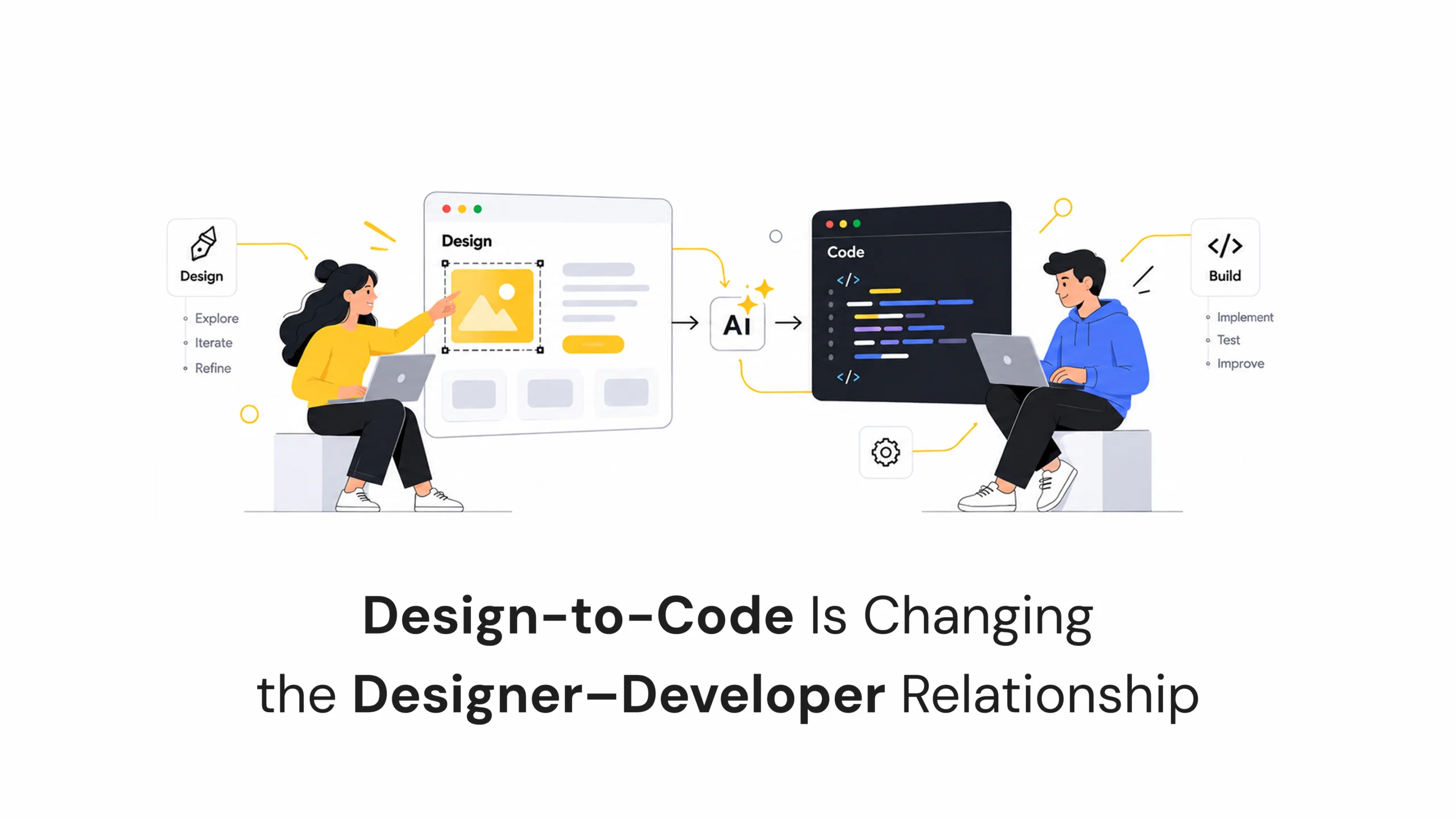
The line between design and development is becoming less defined.
For years, the process was simple: designers created the experience, developers built it, and QA checked the final product. But with AI and design-to-code tools, the distance between a Figma file and working software is becoming much smaller.
This is changing not just how products are built, but also how designers and developers work together.
Design-to-Code Is Changing the Designer–Developer Relationship
- September 18, 2026
- Pavithra R
- 10:00 am
Views: 155
The line between design and development is becoming less defined.
For years, the process was simple: designers created the experience, developers built it, and QA checked the final product. But with AI and design-to-code tools, the distance between a Figma file and working software is becoming much smaller.
This is changing not just how products are built, but also how designers and developers work together.
The Old Handoff Is Breaking Down
The traditional process often looks like:
Design → Handoff → Development → QA
While this workflow works, it can create gaps. A design may look one way in Figma but behave differently once it reaches the browser or app.
Spacing, responsive layouts, interactions and component behaviour can all change during implementation.
Design-to-code tools are helping reduce this gap by bringing design and implementation closer together.
From Handoff to Collaboration
Design and development are moving from separate stages toward a more continuous process.
Instead of designers finishing everything before developers begin, both teams can collaborate earlier.
Designers can explore ideas, developers can test technical possibilities, and AI can help turn those ideas into working prototypes.
The result is a workflow that feels less like a handoff and more like a conversation.
Pixels Are No Longer the Entire Deliverable
A design is more than a collection of screens.
Designers increasingly need to think about:
- Responsive behaviour
- Component states
- Accessibility
- Loading and error states
- Interaction logic
- Design tokens
The question is no longer only “How should this screen look?”
It is also “How should this experience behave?”
AI Can Write the Code. Who Reviews It?
AI can generate code quickly, but generated code still needs human review.
Someone needs to check whether the implementation is:
Usable. Accessible. Responsive. Scalable.
AI can speed up development, but it doesn’t remove the need for design and technical judgment.
The role of designers and developers is increasingly shifting from simply creating everything manually to guiding, reviewing and refining what AI produces.
The Design System Becomes the Common Language
Design systems can connect Figma and code through shared components, tokens and rules.
Instead of repeatedly explaining colours, spacing or button behaviour, teams can work from the same system.
This also gives AI clearer instructions about how a product should look and behave.
A strong design system can therefore become a shared language between designers, developers and AI.
Designers Are Moving Closer to Code
Designers don’t need to become developers.
But understanding basic implementation concepts can make collaboration much easier.
Knowing how responsive layouts, components, accessibility and technical constraints work helps designers create solutions that are easier to build and scale.
Designers are increasingly thinking beyond static screens and closer to real product behaviour.
Developers Are Moving Closer to Design
The shift works both ways.
AI-assisted development allows developers to experiment with layouts, interactions and prototypes much faster.
Developers can now participate earlier in design exploration instead of only receiving a finished design to implement.
This creates more opportunities for both disciplines to influence the final experience.
Is the “Handoff” Dead?
The handoff probably isn’t disappearing completely.
But it may stop being a single moment at the end of the design process.
The future could look more like:
Design ↔ Prototype ↔ Code ↔ Test ↔ Refine
Instead of working in isolated stages, designers, developers and AI can continuously work together to improve the product.
Conclusion
Design-to-code isn’t about designers replacing developers or developers replacing designers.
It’s about reducing the distance between design and development.
As AI, design systems and collaborative tools continue to evolve, the strongest workflows will bring both disciplines closer together.
The future isn’t about removing the people from the process. It’s about removing the gap between them.
Latest Blogs
Work With Us to Create Impactful Digital Experiences
FAQs
What is design-to-code?
Design-to-code is the process of converting design files, prototypes or design specifications into working code. AI-powered tools can now automate parts of this process and speed up implementation.
Will AI replace designers or developers?
AI can automate parts of design and development, but human expertise is still important for product decisions, user experience, accessibility, technical review and problem-solving.
Do designers need to learn coding?
Designers don’t necessarily need to become developers. However, understanding basic coding concepts, responsive behaviour and technical constraints can improve collaboration with developers.
How do design systems help with design-to-code?
Design systems provide shared components, design tokens and rules that can be used across both design and development. This helps maintain consistency and makes translating designs into code easier.