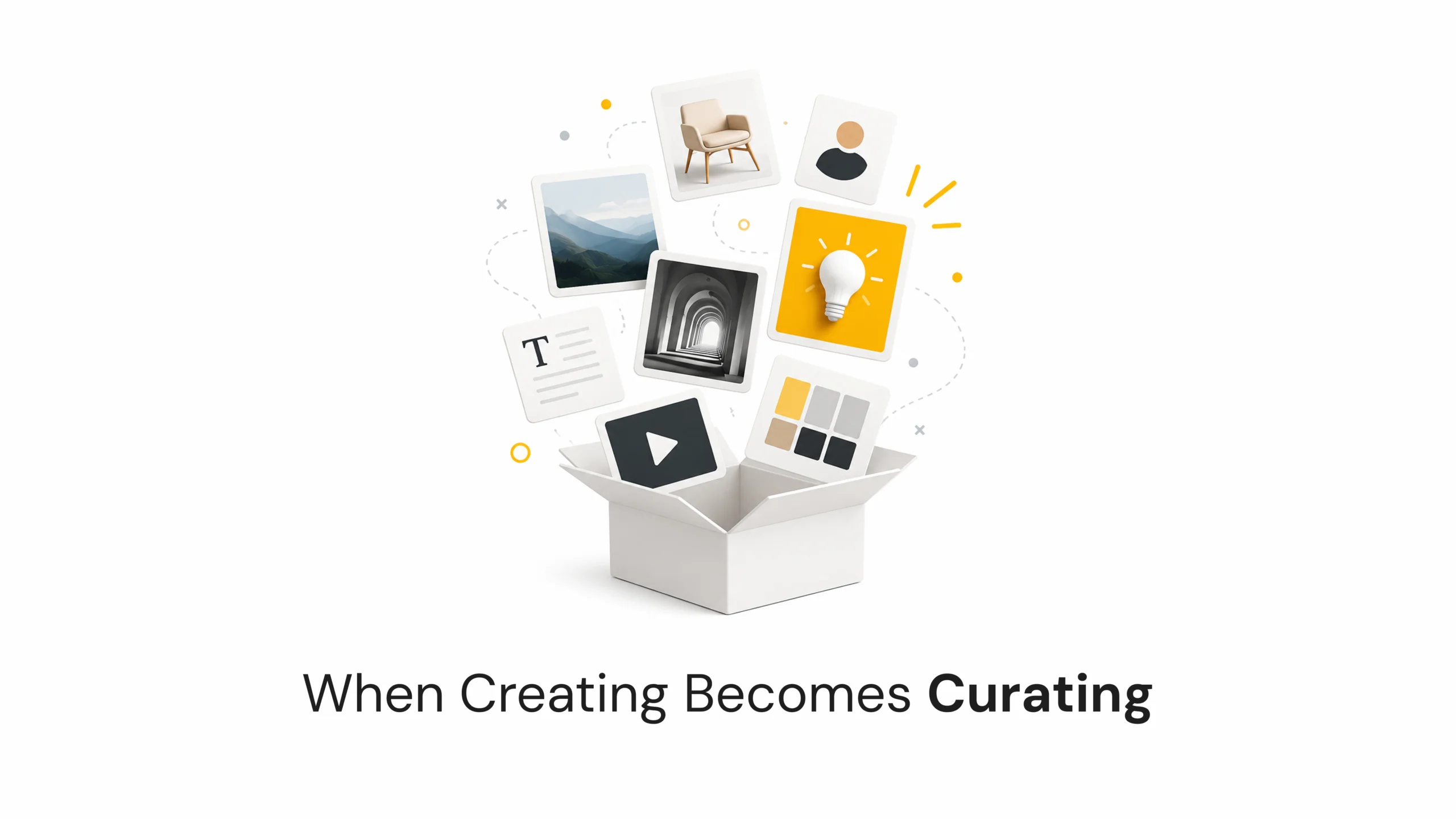
What happens when the hardest part of creativity is no longer creating?
For a long time, creativity was closely connected to making things.
A designer opened a blank canvas. A writer opened a blank document. A filmmaker started with an empty timeline. A developer started with an empty file.
The blank page was where everything began.
When creating becomes curating
- September 5, 2026
- Pavithra R
- 10:00 am
Views: 217
What happens when the hardest part of creativity is no longer creating?
For a long time, creativity was closely connected to making things.
A designer opened a blank canvas. A writer opened a blank document. A filmmaker started with an empty timeline. A developer started with an empty file.
The blank page was where everything began.
You had to come up with the idea, make the first version, realise it wasn’t quite right, try again, change things, remove things, and eventually arrive at something you were happy with.
But the blank page is changing.
Today, AI can give you ideas before you’ve even finished explaining what you’re looking for. It can generate images, write drafts, suggest layouts, create variations, produce code, and turn a rough thought into something that already looks almost finished.
So maybe the question isn’t simply:
“Can you create something?”
Maybe it’s becoming:
“Can you recognise what is worth creating?”
And that is a very different skill.
THE END OF THE BLANK PAGE
AI has made the starting point much easier.
A designer doesn’t always have to begin with an empty canvas. A writer doesn’t necessarily have to stare at a blank document. A creative team can explore multiple directions before deciding which one is worth developing.
At first, that can feel like the end of creativity.
But perhaps it is actually the beginning of a different kind of creativity.
When creating possibilities becomes easier, choosing between those possibilities becomes more important.
Imagine being given 100 ideas.
One looks impressive.
Another is simple.
One feels completely unexpected.
Another feels safe and familiar.
And then there is one that somehow just feels right.
Which one do you choose?
AI can help create the options.
But someone still has to make the decision.
That person isn’t just creating anymore.
They are curating.
CREATION WAS NEVER JUST MAKING
We often describe creativity as the ability to produce something.
But creative work has always involved much more than production.
A designer decides what doesn’t belong on the page.
A photographer chooses one image from hundreds.
A filmmaker removes scenes that took hours to shoot.
A writer changes a sentence because, technically, it works, but it doesn’t feel right.
The work isn’t only in producing something.
A huge part of the work is knowing what to keep and what to let go.
AI doesn’t make that part irrelevant.
In some ways, it makes it even more important.
When producing becomes easier, judgement becomes harder to ignore.
MORE IDEAS CAN MEAN MORE NOISE
There is an interesting problem that comes with having too many possibilities.
When ideas took time to produce, we naturally spent more time with each one.
You might spend an entire afternoon working on a single concept because creating another version meant starting over.
Now you can ask AI for ten versions.
Then twenty.
Then fifty.
Suddenly, having ideas isn’t necessarily the problem.
Knowing which ideas deserve your attention is.
A generated image can look beautiful and still have nothing meaningful to say.
A paragraph can be perfectly written and still feel empty.
A product can have all the expected features and still fail to solve the problem people actually care about.
The more we can produce, the more important our ability to filter becomes.
THE CURATOR HAS A POINT OF VIEW
Curation isn’t simply choosing the “best” option.
It involves having a point of view.
Think about an art gallery.
The curator didn’t necessarily create every piece hanging on the wall. Their role is to decide what belongs together, what deserves attention, what should be placed next to something else, and what story the collection tells.
Creative work is starting to move in a similar direction.
The questions become:
What belongs here?
What doesn’t?
What feels different?
What feels like us?
What would people actually care about?
These decisions require context.
They require experience.
And, most importantly, they require judgement.
TASTE BECOMES MORE VALUABLE
For years, creative professionals have been expected to build technical skills.
Learn Photoshop.
Learn Figma.
Learn typography.
Learn editing.
Learn motion.
Learn code.
Those skills still matter.
But as tools become capable of handling more of the execution, another skill becomes increasingly valuable:
Taste.
Taste isn’t simply knowing whether something looks good.
It’s understanding why it works.
It’s knowing what fits the audience, the brand, the situation, and the moment.
It’s recognising when something is technically impressive but emotionally empty.
And that is difficult to replace with a tool.
AI can give you a thousand options.
But if you don’t know what you’re looking for, a thousand options can actually make the process harder.
FROM PROMPTING TO DIRECTING
There is another change happening quietly.
The creative professional may increasingly become less of someone who executes every individual step and more of someone who directs the process.
Instead of thinking:
“I need to make this.”
The thinking becomes:
“I need to achieve this outcome.”
That difference matters.
A film director doesn’t operate every camera, design every costume, edit every frame, or write every line.
But they need to understand what the film is trying to communicate.
They need to recognise when something works.
They need to question what doesn’t.
They need to push good ideas further.
And they need to know when the work is finished.
AI-assisted creativity works in much the same way.
The better you understand what you’re trying to achieve, the more effectively you can use the tool.
HAS EVERYONE BECOME CREATIVE?
This is where things get interesting.
If AI can generate a logo, illustration, article, video, presentation, or campaign in minutes, does that mean everyone is now a creative?
Not necessarily.
Having access to a tool for creating something isn’t the same as having a creative point of view.
A camera didn’t make everyone a photographer.
Design software didn’t make everyone a designer.
The internet didn’t make everyone a storyteller.
AI won’t automatically make everyone a creative thinker either.
What it does is make creation more accessible.
It lowers the barrier between an idea and something you can actually see.
But the bigger question remains:
Is the idea worth making?
THE NEW CREATIVE ADVANTAGE
Maybe the future doesn’t belong to the person who can create the most.
Maybe it belongs to the person who can choose what deserves to be created.
The person who can look at a hundred possibilities and recognise the one that matters.
The person who can take a generic output and make it specific.
The person who can turn information into insight.
The person who can turn an idea into something people actually connect with.
And the person who knows when AI has helped and when it has simply added more noise.
Because AI can generate.
But someone still needs to question.
Someone still needs to edit.
Someone still needs to refine.
Someone still needs to say:
“This isn’t quite right. Let’s try again.”
And eventually:
“This is the one.”
MAYBE CREATING WAS ALWAYS CURATING
Perhaps this isn’t really a story about AI replacing creativity.
Maybe it’s about recognising what creativity has always involved.
Creating was never only about putting something onto a blank page.
It was about observing.
Choosing.
Rejecting.
Connecting.
Reframing.
Refining.
And giving meaning to something that didn’t have meaning before.
AI simply makes some parts of that process faster.
And when those parts become faster, the decisions around them become more important.
When everything can be created, what you choose to create becomes part of your identity.
And when everyone has access to powerful creative tools, perhaps the real advantage won’t be the ability to generate more.
It will be the ability to see better.
Because the future of creativity may not belong to the fastest creator.
It may belong to the sharpest curator.
Latest Blogs
Work With Us to Create Impactful Digital Experiences
FAQs
What does "When Creating Becomes Curating" mean?
It refers to how AI is changing the creative process. As AI makes it easier to generate ideas, images, writing, designs, and other creative outputs, the ability to select, refine, direct, and give meaning to those outputs becomes increasingly important.
Is AI replacing human creativity?
AI can automate parts of the creative process, but creativity involves more than producing an output. Understanding people, making decisions, developing a point of view, and knowing what is meaningful still require human judgement. AI is better viewed as a creative tool than a complete replacement for creative thinking.
Why is taste important in AI-assisted creativity?
When everyone has access to tools that can generate many possibilities, simply producing something becomes less distinctive. Taste helps people recognise what works, what feels relevant, and what should be improved or rejected. It becomes an important part of turning AI-generated possibilities into meaningful work.
How is the role of creatives changing with AI?
Creatives may spend less time on repetitive execution and more time on direction, decision-making, experimentation, editing, and refinement. Instead of only asking how to make something, they increasingly need to decide what should be made and why.