Over the years, UX design has focused on a single mission – create intuitive digital experiences that are engaging and easy to use. Designers have strived to make websites and applications more accessible and intuitive to address the ever-growing complexity of the digital world and its users’ needs.
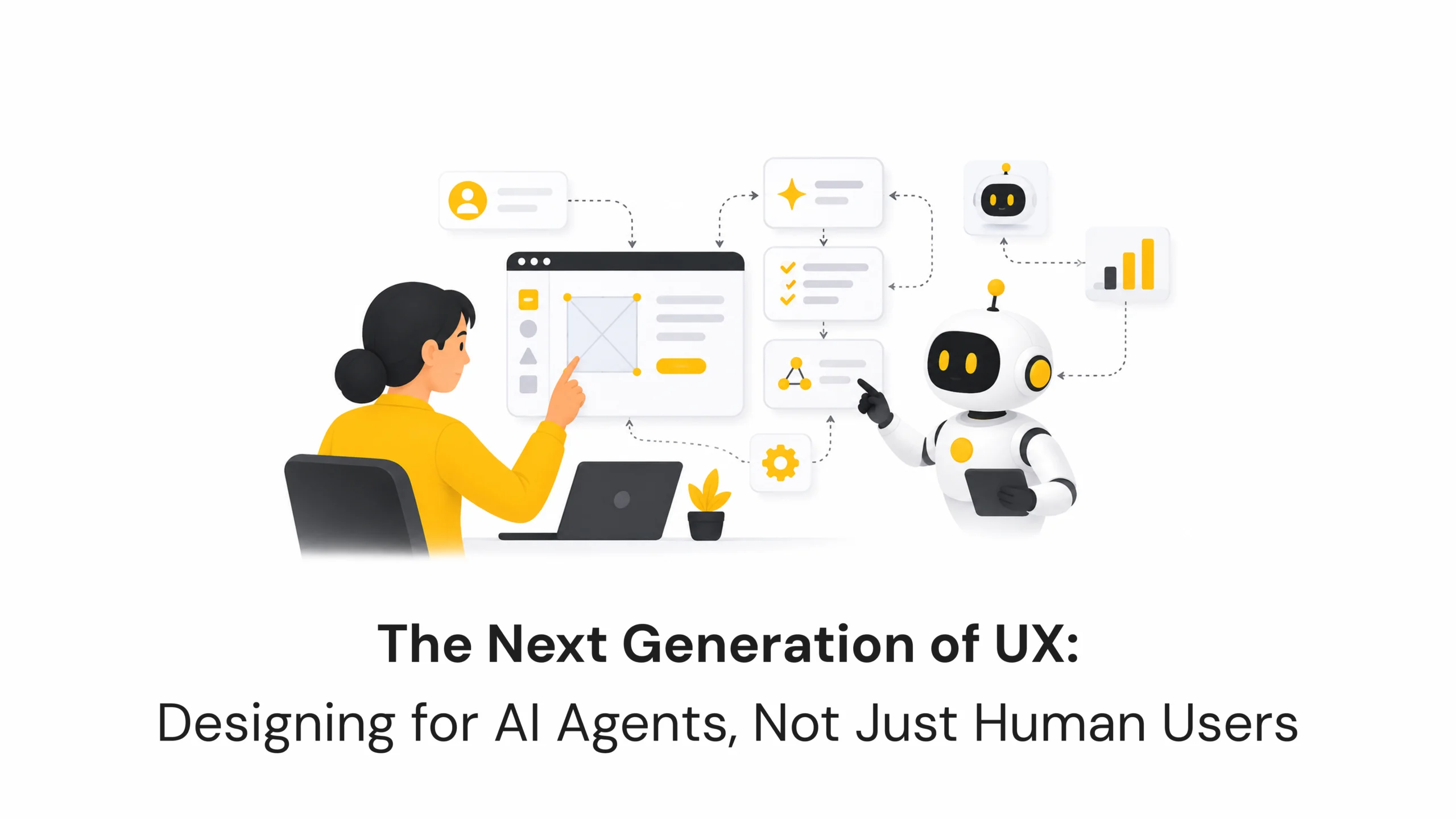
The Next Generation of UX: Designing for AI Agents, Not Just Human Users
- August 6, 2026
- Pavithra R
- 10:00 am
Views: 377
Introduction
Over the years, UX design has focused on a single mission – create intuitive digital experiences that are engaging and easy to use. Designers have strived to make websites and applications more accessible and intuitive to address the ever-growing complexity of the digital world and its users’ needs.
However, as we enter a new era of digital innovation, new challenges to UX design arise. More and more often, we encounter interfaces that are not only controlled by humans but also by AI agents. Unlike conventional chatbots, AI agents are capable of performing a variety of tasks, ranging from simple calculations to complex strategic decision-making.
Businesses and designers should be aware of this paradigm shift and embrace new approaches to UX design.
In this blog, you will learn:
- How AI agents change the UX design industry
- Why businesses should care about this shift
- And some key principles of designing experiences for AI agents and humans
What are AI agents?
AI agents can be described as smart programs that are capable of perceiving information, reasoning, performing actions, and completing tasks with limited human intervention. Compared to conventional chatbots, AI agents can perform a variety of tasks, including:
- Booking flights and hotels
- Planning and scheduling meetings
- Comparing products and recommending purchases
- Managing customer service
- Automating business processes
- Researching information and analyzing data
Why is UX changing?
When it comes to conventional UX design, the user is typically a human being. When creating intuitive interfaces for conventional digital products, designers take into consideration what humans like or dislike about a digital product’s design and layout. They optimize the interface so that users can get from point A to point B within the product quickly, intuitively, and with minimal effort.
However, when designing for AI agents, designers should prioritize features and functions that help AI agents perceive and navigate the interface. For example, unlike humans, AI agents do not care about visual appeal and intuitive navigation – their primary interests are:
- Information architecture
- Semantic content
- Logical organization
- Structured data
Therefore, businesses can benefit from optimizing the design and organization of their online platforms so that they are intuitive not only for humans but also for AI agents.
Human-centered designs are not obsolete. As mentioned above, human users still need to be able to perceive an interface, navigate it intuitively, and achieve their goals without frustrations. However, when it comes to AI agents, designers and developers should be aware that these programs perceive information very differently than humans. Consequently, businesses should prioritize the creation of digital experiences that are intuitive for both human users and AI agents. As such, organizations that embrace AI-ready experiences will be able to offer their customers faster and smarter digital services in the future.
Why businesses should care
UX design is changing, and businesses should embrace these changes. The implementation of AI-powered digital experiences enables organizations to provide customers with faster, easier, and more intuitive digital services.
Below are some reasons why the shift towards AI-ready UX design is beneficial for businesses:
Enhanced customer experience
AI agents help users complete routine tasks, thereby enabling them to achieve their goals faster and with less effort.
Increased productivity
By delegating repetitive tasks to AI agents, businesses can reduce the workload of their employees, which can lead to increased productivity.
Faster decision making
AI agents can analyze vast amounts of data in a short period of time, helping businesses make smarter decisions.
Future-proof digital services
The shift toward AI-ready digital services will enable organizations to meet the demands of tomorrow’s tech-savvy customers.
Key principles of designing for AI agents
Design for the users’ goals
As mentioned earlier, AI agents are goal-driven, meaning that they can perform various tasks and operations, such as analyzing or organizing information. Therefore, designers should create intuitive experiences that help users achieve their goals efficiently. Instead of focusing on making the interface attractive, designers should prioritize task completion.
Create structured content
To help both users and AI agents find relevant information quickly, designers should organize web pages using clear headings and subheadings, informative labels, and a well-structured information architecture.
Ensure transparency
Both human users and AI agents should understand what the AI agent does and does not know, what information it takes into consideration, and when manual intervention is needed.
Keep humans in control
Although AI agents are great at completing routine tasks, there are times when humans need to take over and make decisions. Good UX design will enable human users to review the decisions made by AI agents, undo or confirm actions made by these agents, and see the history of these actions.
Design flexible experiences
Unlike conventional interfaces, the experiences driven by AI agents should be flexible and adaptive. Designers should strive to create adaptive interfaces that respond to individual preferences and behaviors rather than force users to adapt to them.
Common challenges
Designing for AI agents is a challenging task. Businesses and designers should be aware of the following UX-related complexities:
- Privacy and security
- Ethical concerns
- Transparency
- Accessibility
- User trust
- Human oversight
- Regulations and compliance
How Kavinu Design Agency can help
At Kavinu Design Agency, we offer end-to-end digital transformation services. Our team of professional designers and developers can help you create intuitive digital experiences that not only address the needs of your human users but also appeal to AI agents. In addition to conventional UI/UX design services, we provide high-quality website development, design systems, and UX research services.
Final thoughts
The paradigm shift in UX design is inevitable, and businesses must adapt or get left behind. As AI agents become involved in the way we interact with digital products, designers and developers should re-examine their approaches to conventional UX design. In the future, intuitive interfaces will be driven not only by human interactions but also by AI agents, enabling users to complete tasks faster and with less effort.
Businesses that embrace this paradigm shift will be able to provide their clients with intuitive digital services that are driven by AI agents, helping them get from point A to point B quickly and efficiently.
The next generation of UX design is not about the replacement of humans by AI agents. It is about enhancing human-driven digital experiences to make them faster and more efficient.
Latest Blogs
Work With Us to Create Impactful Digital Experiences
FAQs
What is AI Agent UX?
AI Agent UX is about designing intuitive digital experiences for users and AI agents.
How are AI agents different from chatbots?
Unlike chatbots, AI agents can accomplish various tasks while requiring minimal human input.
Why should businesses care about designing for AI agents?
As conventional UX design becomes inadequate, businesses should invest in new solutions that help them achieve their business objectives while satisfying the needs of tech-savvy users.
Does designing for AI agents require new principles?
Although human-centered designs are still important, businesses should consider the needs of AI agents as well.
What are the key principles of designing for AI agents?
The key principles of designing for AI agents are:
- Task-oriented design
- Semantic content
- Transparent decision-making
- Human oversight
- Flexible digital experiences
- Privacy and security
How can Kavinu Design Agency help businesses design intuitive experiences for humans and AI agents?
Kavinu Design Agency offers a wide range of digital transformation services, including UX research, UI/UX design, and web design and development. We can help you create intuitive digital experiences that meet the highest UX standards and deliver exceptional results.